
Illicit Crop Monitoring by using cost-free Sentinel Images
- Hakan Demirbuken
- Nov 25, 2020
- 3 min read
Updated: Dec 30, 2020
Technology helps to monitor the licit and illicit crop cultivation in a more easy and cheaper way. Satellite imagery was very costly not long ago. In addition to this, there was not many options. But, it is possible to reach to cost-free satellite imagery for any country. Sentinel imagery (https://sentinel.esa.int/web/sentinel/home) offers cost free satellite imagery at global level. In addition to this, it is possible to access to the cost free processed imagery through "Mundi Web Services (https://mundiwebservices.com/)". Such as, it is possible to access to the landcover, NDVI , vegetation index type data through Mundi Web services for free.
I developed the illicit crop monitoring methodologies which are still being used by UNODC. I used grid-based sampling approach due to the cost related reasons. However, now, it is possible to use cost free services to monitor the illicit cultivation in Afghanistan and other countries. The entire purpose is to minimize the cost and use the resources for development programmes. For example, UNODC is currently spending US 2.5 million/year to estimate the opium poppy cultivated areas in Afghanistan. Based on our new approach it is possible to decrease the cost to US 50,000 per year.
Our new approach brings more flexibility in sample selection. Instead of block (grid) sampling, we can select parcels. In this way, samples can be distributed to entire region/province/country and not concentrated in certain place. Samples can be selected at district level. As a result, we can make estimations at district level. Overall, this new approach decreases the variance and estimation error margin compare to the block (grid) sampling. In addition to this, with this new approach, we can make estimations for other main crops like cereals at the same time.
Our initial results are very encouraging. We are currently testing the methodology over main poppy cultivation provinces in Afghanistan; Helmand, Kandahar and Nangarhar
I- Results for Helmand Province;
Sample Distribution : We selected randomly 30 agricultural fields per district in Helmand province. Below map presents the selected fields (blue dots) in Helmand and surrounding provinces

We estimate total of 141,569 hectares opium poppy cultivation in Helmand in 2020. Total opium poppy cultivation was around 90,000 hectares (UNODC estimation) in Helmand in 2019. Below table presents the opium poppy and cereal cultivation estimation at district level in Helmand province in 2020

It is estimated that there were total of around 933,000 agricultural fields in Helmand in 2020. Out of this, 394,000 of them were planted with opium poppy, 283,000 of them with cereals and 225,000 of them were with other crops.
Average agricultural field size was 0.37 hectares. Average opium poppy field size was 0.38 hectares in Helmand.
II- Results for Kandahar Province;
Sample Distribution : We selected randomly 30 agricultural fields per district in Kandahar province. Below map presents the selected fields (blue dots) in Kandahar

We estimate total of 20,639 hectares opium poppy cultivation in Kandahar in 2020. Total opium poppy cultivation was around 13,954 hectares (UNODC estimation) in Kandahar in 2019. Below table presents the opium poppy and cereal cultivation estimation at district level in Kandahar province in 2020

It is estimated that there were total of around126,000 agricultural fields in Kandahar in 2020. Out of this, 39,000 of them were planted with opium poppy, 18,000 of them with cereals and 69,000 of them were with other crops.
Average agricultural field size was 0.49 hectares. Average opium poppy field size was 0.47 hectares in Kandahar.
III- Results for NangarharProvince;
Sample Distribution : We selected randomly 30 agricultural fields per district in Nangarhar province. Below map presents the selected fields (blue dots) in Nangarhar

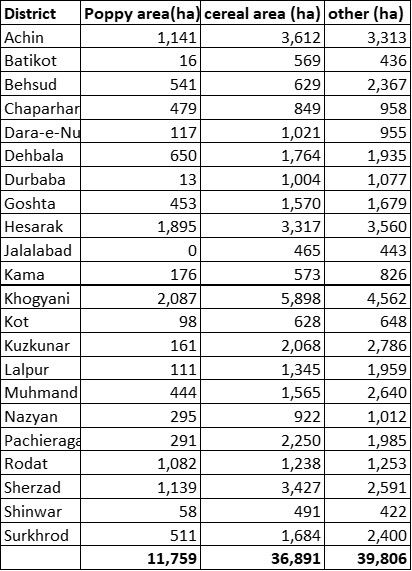
We estimate total of 11,759 hectares opium poppy cultivation in Nangarhar in 2020. Total opium poppy cultivation was around 3,000 hectares (UNODC estimation) in Nangarhar in 2019. Below table presents the opium poppy and cereal cultivation estimation at district level in Nangarhar province in 2020
Ø
Ø
Ø
Comments